

Cross Border Payments Market Analysis: Industry to Reach USD 492.6 Billion by 2035
Cross Border Payments Market
Cross Border Payments Market Size, Share and Research Report By Payment Method (Bank Transfers, Online Payment Gateways, Mobile Money, Digital Wallets)
Cross Border Payments Market is expanding as businesses and consumers increasingly demand faster, secure, transparent, and cost-effective international transactions.”
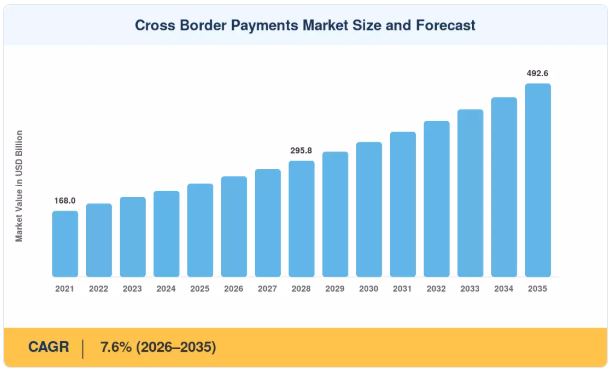
BERLIN, BERLIN, GERMANY, August 26, 2026 /EINPresswire.com/ -- The Global cross border payments market reached an estimated USD 236.8 billion in 2025 and is projected to grow from USD 254.8 billion in 2026 to USD 492.6 billion by 2035, registering a CAGR of 7.6% during the forecast period. Two major catalysts are accelerating this trajectory: the exponential rise in global e-commerce transactions requiring real-time multi-currency settlement, and the proliferation of digital wallet ecosystems and blockchain-based payment rails displacing traditional correspondent banking networks. With over USD 250 trillion in cross-border payment flows processed annually by 2025, financial institutions, fintech platforms, and corporate treasuries face mounting pressure to modernize international payment infrastructure or risk ceding market share to agile digital-native competitors.— Market Research Future (MRFR)
Legacy correspondent banking architectures many built on decades-old SWIFT messaging protocols with multi-day settlement windows and opaque fee structures are rapidly giving way to next-generation payment rails that integrate real-time gross settlement (RTGS) interoperability, blockchain-based smart contracts, and AI-powered FX optimization engines. A recent McKinsey Global Payments report estimated that top-quartile financial institutions deploying modern cross-border payment platforms alongside predictive FX hedging tools achieved 31–36% lower transaction costs than peers still routing through traditional correspondent chains. This technology shift is not incremental it represents a structural re-platforming of how the entire global payments ecosystem moves value across borders.
Get Full PDF Sample Copy of Report: (Including Full TOC, List of Tables & Figures, Chart) @
https://www.marketresearchfuture.com/sample_request/22854
➤ How Significant Is the Cross Border Payments Market’s Growth?
The cross border payments market has demonstrated consistent and robust expansion, rising from approximately USD 34.7 billion in 2021 to an estimated USD 236.8 billion in 2025, representing a healthy historical growth trajectory. The market is expected to nearly triple over the next decade, driven by the accelerating globalization of commerce, explosive growth in international remittance corridors, and the rapid adoption of API-driven payment infrastructure across banking, fintech, and corporate treasury functions.
Rising volumes of international B2B trade payments, gig economy cross-border disbursements, and consumer remittances to emerging economies have created acute demand for faster, cheaper, and more transparent international payment solutions. Multinational corporations, marketplace platforms, payroll processors, and remittance service providers are all investing heavily in modern cross-border payment infrastructure to reduce FX spreads, accelerate settlement cycles, and improve end-to-end payment visibility.
➤ What Does the Future Hold for the Cross Border Payments Market?
Blockchain technology and central bank digital currencies (CBDCs) stand at the forefront of the market’s next growth phase. Distributed ledger-based payment networks are transforming cross-border settlement from a multi-day, multi-intermediary process into a near-instantaneous, low-cost exchange of value. Pilot programs such as Project mBridge a multi-CBDC platform developed by the BIS Innovation Hub alongside central banks in China, Hong Kong, Thailand, and the UAE signal that sovereign digital currency infrastructure will reshape wholesale cross-border payment flows before 2030.
The growing emphasis on payment transparency and regulatory compliance is another defining force shaping the market’s future. ISO 20022 migration now mandated across SWIFT, the Eurozone’s TARGET2 system, and the U.S. Fedwire network is enabling richer payment data to accompany transactions, reducing friction in compliance screening and reconciliation. Platforms offering end-to-end payment tracking, real-time FX rate lock-in, and automated AML/KYC orchestration are displacing legacy correspondent banking relationships.
Embedded finance and API-first payment orchestration is also redefining how businesses access cross-border payment capabilities. With cloud-native payment APIs now enabling any software platform to embed multi-currency accounts, FX conversion, and international wire capabilities, the addressable market for cross-border payment infrastructure has expanded dramatically beyond traditional financial institutions to include e-commerce platforms, SaaS companies, and gig economy marketplaces.
Buy this Premium Research Report at:
https://www.marketresearchfuture.com/checkout?currency=one_user-USD&report_id=22854
➤ Who Are the Key Players in the Cross Border Payments Market?
The cross border payments landscape is characterized by a mix of global banking networks, specialized payment service providers, blockchain-native fintech platforms, and card network operators. Key participants shaping the competitive dynamics include:
SWIFT — operating the world’s leading secure financial messaging network connecting over 11,500 financial institutions across 200+ countries
Visa Inc. — leveraging its global card network and Visa B2B Connect platform to modernize cross-border business payment flows
Mastercard — delivering cross-border payment solutions through its global network and Mastercard Send real-time disbursement platform
PayPal Holdings — providing consumer and SME cross-border payment capabilities across 200+ markets through PayPal and Xoom
Western Union — operating one of the world’s largest cross-border remittance networks with digital and agent-based channels
Ripple Labs — offering blockchain-based cross-border settlement infrastructure through RippleNet and the XRP Ledger
TransferWise (Wise) — disrupting traditional FX spreads with transparent, mid-market rate international transfers for consumers and businesses
Citigroup (Citi Treasury and Trade Solutions) — delivering enterprise cross-border payment and liquidity management solutions to multinational corporations
JPMorgan Chase (JPM Coin / Onyx) — pioneering blockchain-based intraday cross-border settlement for institutional clients
Airwallex — providing API-first global payment infrastructure enabling businesses to collect, hold, and send funds in 150+ currencies
Competition in the market is intensifying as established players race to embed real-time payment capabilities, expand CBDC pilot partnerships, and integrate AI-powered compliance screening and FX optimization engines. Strategic alliances between traditional banks, fintech disruptors, and central bank digital currency programs are fundamentally reshaping the competitive hierarchy of global cross-border payments.
➤ What Are the Emerging Trends in the Cross Border Payments Market?
Several transformational trends are redefining how the cross border payments market evolves through 2035:
Blockchain & Distributed Ledger Adoption: Permissioned blockchain networks and public ledger protocols are enabling near-instantaneous, low-cost cross-border settlement with full auditability, bypassing multi-correspondent banking chains that add days and cost to international transactions.
Central Bank Digital Currency (CBDC) Integration: Over 130 countries are actively exploring or piloting CBDCs, with multi-CBDC interoperability platforms such as Project mBridge and Project Nexus positioned to fundamentally restructure wholesale and retail cross-border payment flows.
ISO 20022 Migration: The global transition to the ISO 20022 financial messaging standard is enabling richer, structured payment data to accompany transactions dramatically improving compliance screening, reconciliation, and straight-through processing rates.
AI-Powered FX Optimization & Compliance: Machine learning models are transforming FX rate management and AML/sanctions screening enabling real-time risk scoring, dynamic routing optimization, and false-positive reduction across high-volume payment corridors.
Embedded Cross-Border Payments: API-first payment orchestration platforms are enabling non-financial businesses from e-commerce marketplaces to SaaS platforms to embed multi-currency accounts and international payment capabilities directly into their product experiences.
Real-Time Cross-Border Interoperability: Linkage of domestic instant payment systems (India’s UPI, Singapore’s PayNow, the EU’s SEPA Instant) is creating regional real-time cross-border payment corridors that dramatically reduce cost and latency for consumer and SME transactions.
Get access to the full description of the report @
https://www.marketresearchfuture.com/reports/cross-border-payments-market-22854
➤ How Is the Cross Border Payments Market Segmented?
The cross border payments market report provides a comprehensive segmentation framework:
1 By Payment Type: B2B Payments, B2C Payments, C2C Remittances, C2B Payments
2 By Payment Method: Bank Transfers (SWIFT/SEPA), Card Networks, Digital Wallets, Blockchain/Cryptocurrency, Mobile Money
3 By End-Use Vertical: BFSI, Retail & E-Commerce, Healthcare, IT & Telecom, Travel & Hospitality, Energy & Commodities
4 By Enterprise Size: SMEs, Large Enterprises, Individual Consumers
5 By Channel: Banks & Financial Institutions, Money Transfer Operators, Fintech Platforms, Payment Service Providers
➤ What Are the Regional Insights from the Cross Border Payments Market?
North America commands approximately 36% of global cross border payments market share, underpinned by the sheer scale of U.S. corporate trade finance, international payroll disbursements, and the deep integration of U.S. dollar correspondent banking networks in global trade settlement. The region’s mature fintech ecosystem, early API banking adoption, and proximity to major Latin American remittance corridors further reinforce its leading position.
Europe holds the second-largest share at approximately 28%, with the United Kingdom, Germany, and the Netherlands representing the primary markets. SEPA Instant Credit Transfer expansion, PSD2-driven open banking mandates, and the European Central Bank’s digital euro initiative are compelling European banks and payment service providers to invest heavily in next-generation cross-border payment infrastructure and real-time FX settlement capabilities.
Asia-Pacific represents a rapidly growing region, driven by the explosive expansion of intra-regional trade flows between China, Japan, South Korea, India, and Southeast Asia, alongside record-high remittance volumes from overseas Asian diaspora communities. The integration of domestic real-time payment systems including India’s UPI, Singapore’s PayNow, and Thailand’s PromptPay into bilateral cross-border corridors is a defining characteristic of APAC market development.
Africa is projected to register the highest CAGR at approximately 11.4% through 2035. Mobile money proliferation anchored by platforms such as M-Pesa, MTN Mobile Money, and Airtel Money is enabling cross-border payment access for unbanked and underbanked populations across Sub-Saharan Africa, while pan-African trade integration under the African Continental Free Trade Area (AfCFTA) is driving formal cross-border B2B payment volumes.
South America and the Middle East round out the global picture, with Brazil, Mexico, Saudi Arabia, and the UAE representing the most active markets for cross-border payment platform adoption. Brazil’s PIX instant payment system and Saudi Arabia’s Vision 2030 financial infrastructure modernization program are notable catalysts driving regional market expansion.
➤➤➤ Industry Analysis Reports by Market Research Future:
Ultrafast Laser Market-
https://www.marketresearchfuture.com/reports/ultrafast-laser-market-5591
Nano Gps Chip Market-
https://www.marketresearchfuture.com/reports/nano-gps-chip-market-5651
Pressure Transmitters Market-
https://www.marketresearchfuture.com/reports/pressure-transmitters-market-5667
Fiber Optic Connector Market-
https://www.marketresearchfuture.com/reports/fiber-optic-connector-market-5752
Geotechnical Instrumentation And Monitoring Market-
https://www.marketresearchfuture.com/reports/geotechnical-instrumentation-monitoring-market-5842
Penetration Testing Market-
https://www.marketresearchfuture.com/reports/penetration-testing-market-5847
Intelligent Power Module Market-
https://www.marketresearchfuture.com/reports/intelligent-power-modules-market-5881
Failure Analysis Market-
https://www.marketresearchfuture.com/reports/failure-analysis-market-6092
Blockchain In Fintech Market-
https://www.marketresearchfuture.com/reports/blockchain-fintech-market-6368
Alcohol Sensor Market-
https://www.marketresearchfuture.com/reports/alcohol-sensor-market-6451
Market Research Future
Market Research Future
+1 855-661-4441
email us here
Legal Disclaimer:
EIN Presswire provides this news content "as is" without warranty of any kind. We do not accept any responsibility or liability for the accuracy, content, images, videos, licenses, completeness, legality, or reliability of the information contained in this article. If you have any complaints or copyright issues related to this article, kindly contact the author above.
